The 5 key phases of the product development process (with examples)
Your team ships faster than ever, but are you losing the context behind each decision? Engineering, product, and design teams now juggle tighter budgets, distributed collaboration, and rising customer expectations all at once.
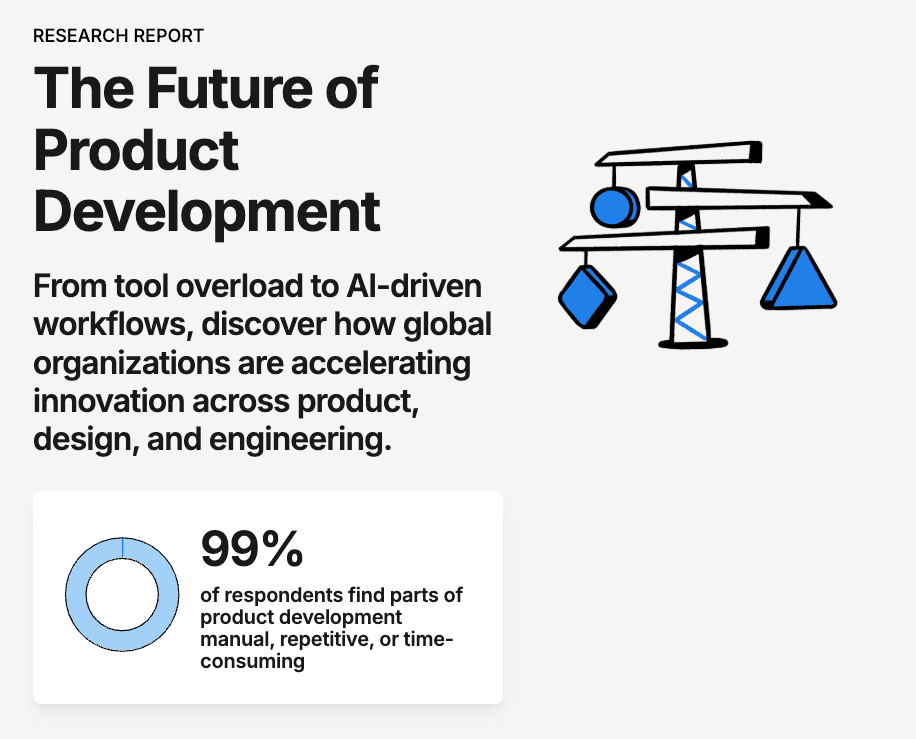
Notion's Future of Product Development research reveals that 99 percent of EPD teams find some part of their process to be manual, repetitive, or time-consuming, while only 33 percent feel fully aligned with their cross-functional partners.¹ That fragmentation reduces speed and quality, meaning you spend more time re-explaining old decisions than making new ones.
This guide shows you how to build a product development process that balances speed with structure so your team can move from discovery to launch without losing context along the way.
What does the product development process help teams achieve?
The product development process is the framework teams use to identify customer problems, define solutions, build products, and improve them based on real-world feedback.
Product development turns customer needs into real value—from idea generation and product discovery through design, build, launch, and iteration. For engineering, product, and design teams, your process acts as the operating system that helps you prioritize problems, identify trade-offs, manage risk, and ship with confidence.
A strong process delivers strategic outcomes that directly impact your business:
Faster delivery with less rework. When your team knows what to build and why, you eliminate the back-and-forth that slows delivery. Clear decision-making frameworks and connected documentation mean less time attending alignment meetings and more time building.
Reduced risk. By surfacing assumptions early, validating product ideas before heavy investment, and creating checkpoints where you can course-correct, you avoid costly late-stage pivots and ship features that solve the right problems.
Stronger cross-functional alignment. Keeping product, design, and engineering in sync ensures everyone works from the same source of truth. Shared context translates to fewer surprises, clearer handoffs, and less rework.
Measurable business impact. When you define success metrics up front and track them through launch, you tie product work directly to outcomes, whether that's revenue, retention, efficiency, or user satisfaction.
The challenge is that most teams run their process across fragmented tools: research in one app, specs in another, designs somewhere else, and tasks in yet another system. This creates silos, slows decision-making, and makes it nearly impossible to see the full story behind any initiative.
A connected workspace helps keep discovery notes, requirements, decisions, tasks, and launch plans tied together so the process supports day-to-day execution instead of fighting it.
Who should be part of the product development process?
Product development works best when it’s shared across functions, not handed off from one team to the next. In practice, that usually means product, engineering, and design working from the same context from the start, then pulling in partners like marketing, sales, support, or data when their input becomes relevant.
At a minimum, most product initiatives involve:
A product manager to define the problem, prioritize trade-offs, and keep the work tied to outcomes
An engineering lead to assess feasibility, shape implementation, and guide delivery
A designer to translate user needs into workflows, interfaces, and interactions
Cross-functional partners to support launch readiness, customer communication, and feedback loops
Engineering should weigh in during discovery, when technical constraints or platform opportunities shape what’s realistic. Design should help frame the problem before solutions are locked in. Support and sales should share recurring customer pain points early, rather than waiting until a feature is already built.
This is where connected documentation matters. When research, specs, mocks, tasks, and launch notes live in one workspace, team members can contribute in context instead of waiting for a meeting or tracking down the latest version of a doc.
In Notion, teams can keep that shared context visible across every phase, which makes collaboration feel more like continuous work and less like a series of handoffs.
What are the 5 phases of product development?
Modern EPD teams typically move through five broad phases during new product development: discovering the problem, defining the opportunity, designing the solution, , and launching and scaling. These key stages overlap, and you'll loop back as you learn, but they give you clear decision points and shared expectations.
Phase 1. Problem discovery and opportunity assessment
Pull signals from support tickets, sales calls, market research, usage data, and competitive gaps. Look for patterns across sources, not one-off requests. Answer three questions: Who is struggling? What's the friction? How often does it happen?
Goal: Build conviction during ideation and product discovery that a problem is worth solving before committing real resources.
Key deliverables: Include your opportunity brief, interview synthesis, and prioritized problem list.
Decision gate: Have product management confirm the problem is worth pursuing before moving to definition.
How to approach in Notion: Centralize product discovery by linking interview notes, customer feedback, and early brainstorming and hypotheses in a single database with fields for impact, confidence, and effort. This makes prioritization transparent and keeps decisions out of side conversations.

Template
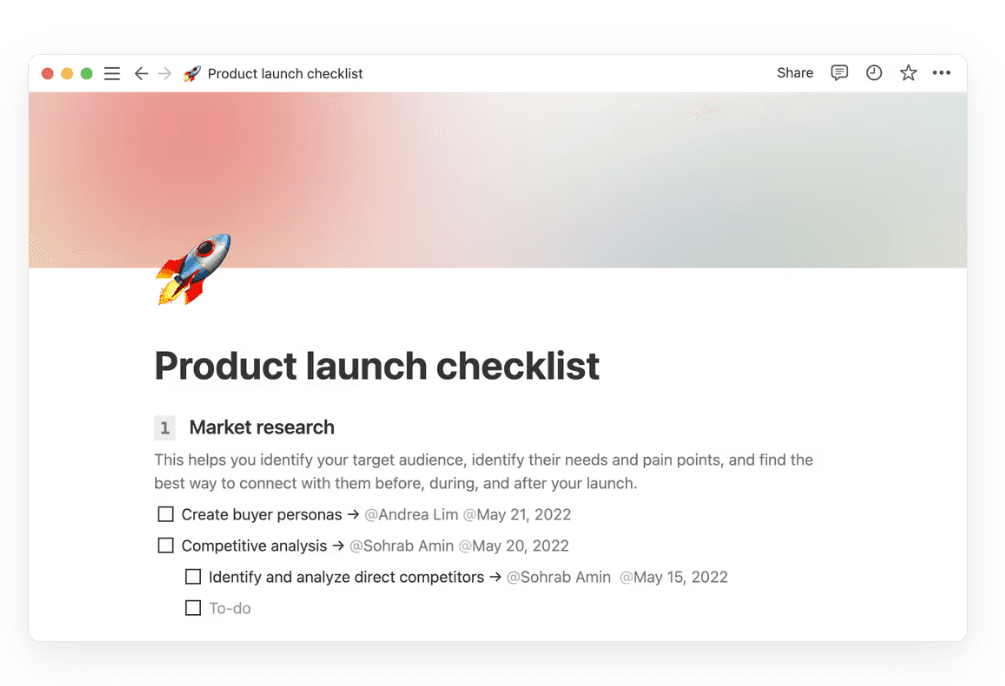
Notion's product plan template gives teams a ready-made structure for tracking opportunities from first signal to go/no-go decision.
Phase 2. Concept development and business case
Analyze how competitors and your target market solve this problem today. Validate demand through interviews, surveys, test marketing, and quick experiments like landing pages or limited betas. With the 2024 Protolabs Trends report indicating that shortening product development cycles increases risk, front-loading validation reduces the odds you'll invest months in something that never lands.
Goal: Turn a validated problem into a clear opportunity with a defensible business case.
Key deliverables: Include a competitive analysis, business analysis, validated demand signal, go/no-go recommendation, and feasibility assessment.
Decision gate: Have stakeholders align on scope, target segment, and opportunity size and viability before design begins.
How to approach in Notion: Capture your problem statement, value proposition, target segment, and opportunity size in a short opportunity brief linked directly to your research.

Helpful Tip
For teams doing this work repeatedly, Notion AI can help synthesize interviews and draft first-pass briefs while a Custom Agent automates recurring concept-stage work like compiling updates for a review page or routing approved opportunities into a shared roadmap.
Phase 3. Product requirements and solution design
Focus on minimum viable artifacts: the problem to solve, user scenarios, non-negotiable requirements, and success metrics. Avoid bloated specs that go stale before engineering picks them up.
Goal: Translate the opportunity into a buildable product concept, with PM, design, and engineering aligned on the product vision and what ships first.
Key deliverables: Include PRD, user stories, acceptance criteria, design mocks or flows, technical constraints, and clearly defined success metrics.
Decision gate: Have engineering and design confirm the solution is feasible and scoped before the build begins.
Phase 4. Build, test, and iterate
Build the smallest version that validates your core assumptions: a minimum viable product (MVP), prototype, beta, or internal pilot. Run quality assurance and usability tests, instrument key flows, and limit rollouts so you can optimize before scaling.
Goal: Turn your concept into working software through tight feedback loops, not waterfall handoffs.
Key deliverables: Include working build, test results, updated backlog, and iteration decisions.
Decision gate: Identify defined exit criteria (error rate, task completion, qualitative confidence) before moving to product launch.
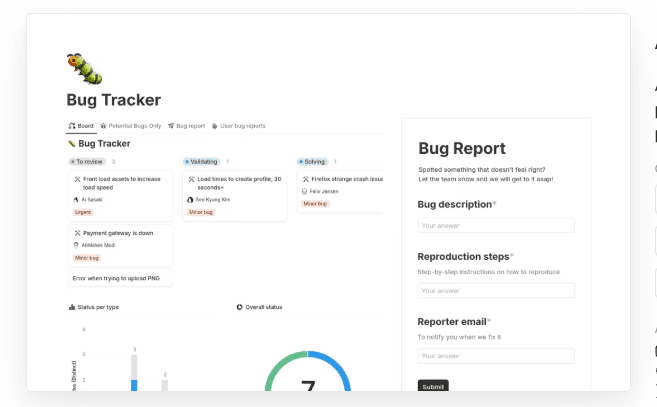
How to approach in Notion: Use Notion's to help engineering manage sprints and track progress against goals in the same workspace where meeting notes and requirements live. Pair it with the to keep QA, engineering, and product aligned on what's blocking launch.
Helpful tip
A Notion Custom Agent can monitor project pages or databases, draft status updates, summarize sprint changes, flag blocked work, or route recurring handoff signals so teams spend less time on coordination tasks and more time resolving the issues themselves.
Phase 5. Launch, measure, and scale
Product and go-to-market teams finalize positioning, rollout plans, and enablement. Engineering manages launch safety: feature flags, phased rollouts, performance monitoring. The question isn't just "did we ship?" but "did we move the number?"
Goal: Move to market launch confidently, with success metrics defined upfront and outcomes tied back to intent.
Key deliverables: Include your launch plan, enablement docs, rollout checklist, and success metric dashboard.
Decision gate: Complete a post-launch review comparing outcomes against the success criteria defined in Phase 3.
How to approach in Notion: Connect your launch plan, enablement docs, and performance dashboards to the original PRD so everyone can trace outcomes back to intent.
Template
Notion's top 10 free product roadmap templates are a good starting point for teams building out their ongoing planning and scaling rhythm.
What key components keep product development on track?
A good process balances agility with accountability. You don't need heavy governance, but you do need a few non-negotiables so work moves quickly without creating chaos.
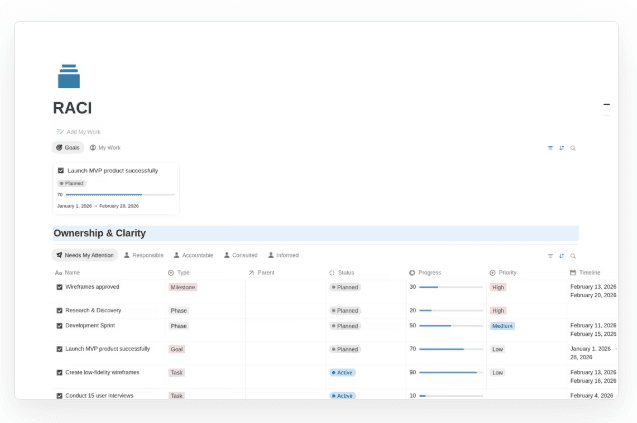
Clear ownership. Every initiative should have a directly responsible PM, an engineering lead, and a design owner. Use a simple DACI or RACI model so it's obvious who decides, who contributes, and who's informed.
Minimum viable artifacts. Agree on the smallest set of docs you always create: a problem statement, a one-page PRD, product design mocks or flows, and a launch checklist. Consistency matters more than format. When these live in one place, new teammates can get up to speed fast.
Connected documentation. Specs, designs, timelines, and launch plans shouldn't live in separate silos. Use Notion to link databases for user research, PRDs, tasks, and launches so each artifact stays connected. This reduces handoff friction and makes it easier to trace decisions back to their original context.
Shared success metrics. Help teams move faster by agreeing early on what success looks like. That could mean adoption, activation, error reduction, retention, or internal efficiency—but it should be visible in the same system where the work is planned and tracked.
Which product development methodology should your team choose?
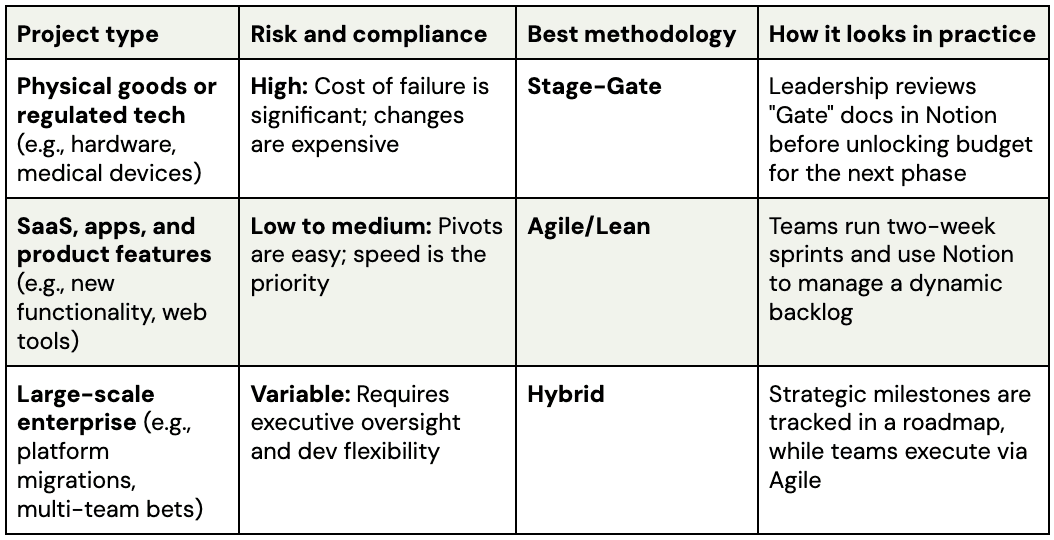
The methodology you choose should streamline each of the product development phases above. The right choice depends on your product, risk profile, and team maturity. While many organizations blend approaches rather than strictly following one playbook, the goal is to choose the lightest process that helps your team stay aligned, make decisions clearly, and keep shipping.
Stage-Gate: Breaks work into defined phases with review points between them. It’s most useful for high-risk projects—like hardware, regulated products, or big bets where changes are expensive.
Agile/Lean: Agile and Lean methodologies prioritize small batches, fast feedback, and continuous learning. They’re a strong fit for most software teams, especially when iterating on existing products. Teams still move through discovery, definition, design, build, and launch—but in shorter loops.
Hybrid: Combines structured oversight with flexible delivery. A team might use Stage-Gate for major milestones, then run Agile within each approved initiative. That balance works well for teams managing complexity without wanting a rigid process. The key is keeping plans, decisions, and day-to-day execution connected so work doesn’t drift across tools.
Use this quick reference guide to match each methodology to your project’s risk, complexity, and speed requirements:
Best practices for streamlining your product development process
No matter which methodology you choose, a few core practices separate teams that ship a successful product with confidence from those that constantly fight their own process. These three habits address the biggest product development team pain points: maintaining context across handoffs, reducing coordination overhead, and scaling decision-making without adding bureaucracy.
Keep context intact across handoffs
Every time work moves from product to design or design to engineering, you risk losing the "why." The result is that engineers build the wrong thing, designers rework specs they misunderstood, and PMs spend hours re-explaining decisions in Slack threads.
In Notion, engineers can open a task and immediately see the associated user research, original problem statement, and design rationale—no digging required. It's how ships 30 percent faster with one central hub for end-to-end product development.
Reduce coordination overhead with clear ownership and decision rights
Ambiguous ownership creates bottlenecks. Teams waste time in alignment meetings where no one knows who can actually decide—or worse—everyone assumes someone else is driving. Product teams that embed ownership matrices in their Notion project pages cut decision latency and eliminate the "checking with stakeholders" loop that adds days to simple calls.
For each project, define who's driving (the DRI), who's approving, who's contributing, and who just needs updates. Put that directly in the project page using a simple DACI or so people know when to weigh in and when to trust others to move forward.
Scale decision-making with AI
Product teams collect more input than they can reasonably digest: interviews, usability tests, support tickets, stakeholder comments. Without a way to synthesize that signal, valuable insights get buried, and teams either ignore feedback or drown in it.
With Notion AI, teams can turn multiple interview transcripts into a concise, thematic summary, pull patterns across support tickets, or draft initial PRDs from discovery notes you refine in minutes.
Build your product development process in Notion
A strong product development process should make work clearer, not heavier. When research, specs, tasks, and launch plans live in different tools, teams lose time re-explaining decisions and reconnecting context.
Notion helps you keep the whole process connected in one workspace—from early discovery through launch. Start with templates for planning, specs, and sprint management, then shape the system around how your team actually works. As your workflow grows, Notion AI can help with synthesis and drafting, while Custom Agents take repetitive coordination work off your team’s plate.
If you want to build a product development process that’s easy to run, scale, and work in, explore Notion today.
¹Notion, "The Future of Product Development" research report (n=1,350). Questions: How many tools does your EPD team juggle daily?; What percentage of your product development process is manual, repetitive, or time-consuming?